Sweet Cube Match Puzzle
Reviews
Description
Matching Mechanics and Core Loop
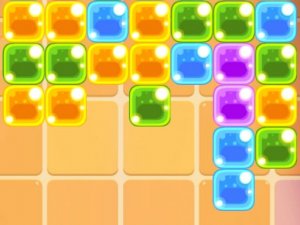
In Sweet Cube Match Puzzle, colored cubes descend slowly through a vertical play area. Your only action is to click or tap a group of two or more cubes that share the same color. When you do, those cubes vanish and the remaining cubes shift down to fill the gap. New cubes keep falling, so the pile never stops growing unless you clear groups fast enough. The game ends when the stack reaches the top of the screen. Points scale with group size, which means a single large cluster is worth more than several small ones.
Why Group Size Changes Your Strategy
Because larger groups award more points and remove more cubes at once, the obvious move is not always the best one. A small group near the bottom might be easy to clear, but waiting for it to merge with same-colored neighbors could yield a bigger payoff. At the same time, the falling speed increases gradually, so hesitation has a cost. The tension between clearing now and clearing bigger is the main decision you make each round.
Controls, Devices, and Session Length
The controls are limited to a single input: click with a mouse or tap with a finger. That simplicity makes the game playable on a computer, tablet, or phone without installing software or creating an account. Rounds are short by design, which suits quick breaks. The visual style uses distinct bright colors for each cube, so matching sets are easy to spot even as the board fills up.
Who This Suits and How to Improve
Sweet Cube Match Puzzle is built for players who want a light mental warm-up rather than a long campaign. Children and adults can both pick it up because there are no complex rules to learn. To score higher, watch the top of the play area as carefully as the bottom, since the game ends on height, not on time. Practicing color recognition and planning one move ahead will help as the descent speeds up.
Compatibility
Faq
Player Comments
Sign in to comment
You must be logged in before posting a review or rating.
No comments yet. Be the first to comment!










Editorial Notes