HexaShift Tile Match Puzzle
Reviews
Description
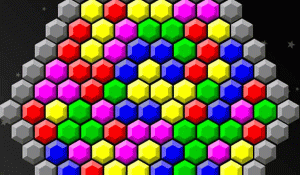
Sliding Rows on a Hexagonal Board
Most color-matching puzzles use square grids and let you swap individual tiles. HexaShift changes both assumptions. The board is hexagonal, and your only action is to click and drag a whole row of tiles upward or downward. That single restriction reshapes how you plan: you cannot nudge one stubborn tile into place. Instead, you reposition an entire line and accept the consequences for every tile inside it.
Matching, Clearing, and Refilling
Your objective is to bring three or more tiles of the same color into a continuous line. When that happens, the matched tiles vanish, points are awarded, and fresh tiles drop in from the top to fill the gaps. Longer lines score higher, so the game rewards setups that clear several tiles at once rather than quick single matches. Because new tiles enter from above, the board state after every clear matters as much as the clear itself.
No Timers, No Penalties
HexaShift has no countdown and no move penalty. You can study the board for as long as you like before dragging a row. That design choice makes the game a candidate for players who want logical exercise without pressure, and it also means mistakes come from misreading the board rather than from rushing. The interface is kept clean on both desktop and mobile browsers, and the input describes no interrupting ads, which supports a family-friendly pace.
Reading the Ripple Effect
Shifting one row moves every tile in it, which can break an existing alignment or set up a new one two rows away. Experienced players learn to scan for chains before touching anything, then check how the move affects adjacent rows. The input notes that puzzle complexity increases over time, so early boards teach the mechanic while later ones demand longer planning sequences. A best-score tracker, described as possibly included, gives repeat players a personal benchmark.
Compatibility
Faq
Player Comments
Sign in to comment
You must be logged in before posting a review or rating.
No comments yet. Be the first to comment!










Editorial Notes